





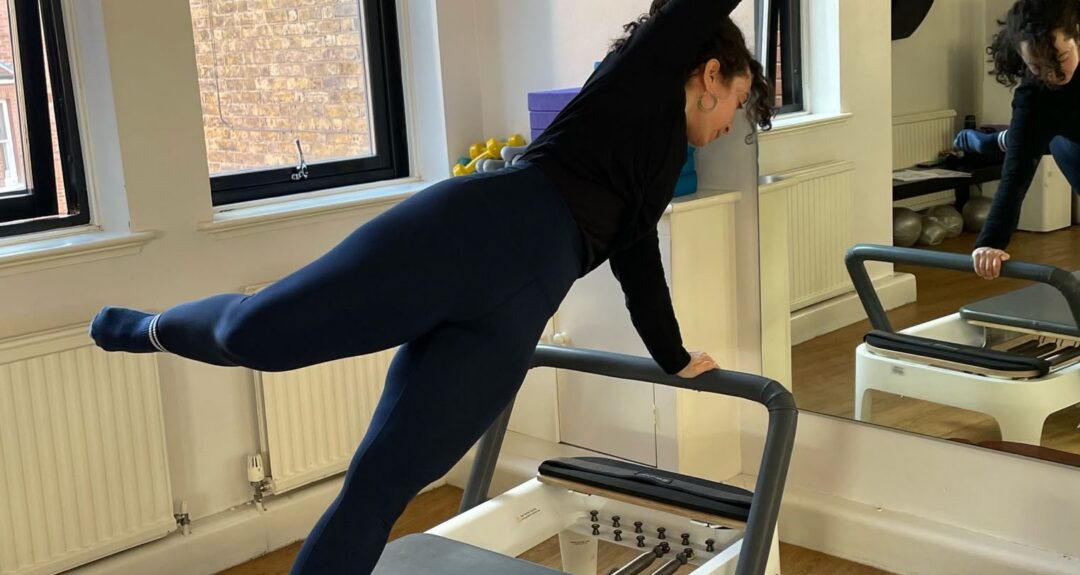
Written by Elisa Withers. APPI Founder and Director, Physiotherapist and Pilates Instructor.
Think you’re ready for Advanced Reformer Pilates?
Advanced Reformer Pilates is about far more than making a class harder.
At the highest level of the Pilates method, exercises demand exceptional strength, control, balance, coordination, mobility, flexibility and body awareness. You need to understand your own movement, recognise when technique starts to change and have the control to correct it.
And that’s what makes advanced Pilates different.
It isn’t simply about doing more exercises, moving faster or adding heavier springs. It’s about mastering movement.
What is Advanced Reformer Pilates?
Advanced Reformer Pilates represents the highest level of progression within the traditional Pilates repertoire.
Advanced practitioners may work towards challenging exercises such as:
- Snake
- Star
- Control Balance
- Advanced Teaser variations
- Tendon Stretch
- Complex transitions between exercises
- Inverted or partially inverted positions
These movements require much more than strength alone. They can involve multi-joint and multi-planar movement, end-range strength and mobility, balance, coordination and precise control.
The Reformer adds another layer of challenge because you need to manage the moving carriage, springs and equipment while maintaining alignment and control.
That is why advanced Pilates isn’t simply a fitness challenge.
It’s a movement skill.
What makes Pilates “advanced”?
One of the biggest misconceptions is that Pilates becomes advanced simply because you’ve been attending classes for a long time.
It doesn’t.
You could have completed hundreds of Reformer classes and still need more time to develop the strength, mobility or technical control required for advanced repertoire.
Equally, an energetic Reformer class involving hand weights, high repetitions or fitness-style exercises can be extremely challenging without being Advanced Pilates in the classical sense.
Advanced Pilates is defined by the complexity and mastery of the movement, not simply by how difficult or exhausting the class feels.
Advanced Pilates requires:
Strength
The ability to generate and control force throughout a movement.
Core control
Maintaining trunk and pelvic control while the limbs move through challenging positions.
Mobility and flexibility
Having enough available range of movement to perform exercises safely and effectively.
Balance and coordination
Controlling multiple moving parts at once, often while the Reformer carriage is moving beneath you.
Body awareness
Understanding where your body is in space and recognising when your technique needs to change.
Movement precision
Executing the exercise with control rather than simply getting from one position to another.
Self-correction
Being able to recognise and modify your own movement without relying on constant teacher intervention.
This level of body awareness is particularly important as exercises become more complex and the margin for error becomes smaller.
Is Advanced Reformer Pilates suitable for everyone?
No — and that’s a good thing.
Advanced classes should be appropriately challenging, but they should also be safe and well matched to the people taking them.
The aim isn’t to rush clients into advanced exercises. It’s to build the foundations that allow them to perform those exercises with confidence and control.
A strong intermediate practice is therefore much more important than simply having a long Pilates history.
When am I ready for Advanced Reformer Pilates?
There isn’t a magic number of classes that makes someone “advanced”.
Instead, ask yourself:
- Can I confidently set up and adjust the Reformer independently?
- Do I understand the fundamental Pilates principles and terminology?
- Can I maintain good alignment and control when exercises become challenging?
- Can I move smoothly between exercises?
- Do I understand my own strengths and limitations?
- Can I recognise when I need to reduce the intensity or modify an exercise?
- Can I safely transition between movements?
- Can I perform challenging exercises such as Teaser with good control?
- Do I feel confident managing the equipment without constant instruction?
If the answer is generally yes, you may be ready to explore the next level.
Your teacher will also assess your technique and suitability within the class.
Advanced Pilates is earned through movement quality — not a class attendance count.
Why is control so important in Advanced Pilates?
At an advanced level, getting into the position isn’t enough.
You need to be able to control the movement into the position, maintain it and come out of it safely.
This is particularly important for exercises involving complex transitions, end-range positions or changes in orientation.
A movement may look impressive on Instagram, but appearance isn’t the same as technical mastery.
The ability to control your movement is what matters.
And that’s why advanced exercises should be taught progressively by an appropriately qualified Pilates teacher who understands the exercise, its prerequisites and its potential risks.
Instagram can provide inspiration. It can’t assess your movement.
Does Pilates actually improve strength, flexibility and balance?
Research suggests Pilates can improve several aspects of physical function, although the quality and certainty of evidence varies depending on the outcome and population.
A 2024 systematic review and meta-analysis involving 39 studies and 1,770 older adults found that Pilates was associated with improvements in static and dynamic postural balance compared with control interventions, although the authors noted that the certainty of evidence ranged from very low to moderate (1).
Another systematic review found Pilates improved balance, strength, flexibility and functional performance in older adults compared with habitual activity or no exercise (2).
However, Pilates should not be presented as a superior form of strength training for every goal. A systematic review comparing Pilates with other exercise modalities found no clear difference in several measures of muscle strength (3).
The takeaway?
Pilates can be a valuable way to develop movement control, balance, flexibility and physical function — but the right exercise method depends on the individual and their goals.
Advanced Pilates is ultimately about mastery of the method, rather than claiming that advanced exercises are automatically better for you.
What are the benefits of Advanced Reformer Pilates?
For the right practitioner, progressing to advanced repertoire can provide a new level of physical and technical challenge.
Greater movement control
Complex exercises require you to coordinate your whole body rather than isolate one muscle or movement.
Improved body awareness
Advanced work challenges your ability to understand where your body is in space and make precise adjustments.
Strength through greater ranges
Some advanced exercises challenge strength and control at end ranges of movement, where appropriate mobility and technique are essential.
Balance and coordination
Advanced exercises often combine multiple movement demands simultaneously, requiring concentration and control. Evidence
A deeper understanding of Pilates
Progressing through the repertoire gives experienced practitioners the opportunity to explore the Pilates method in greater depth.
But perhaps the biggest benefit is simple:
It gives you something to master.
What is the difference between Intermediate and Advanced Reformer Pilates?
The difference isn’t simply that Advanced Pilates is “harder”.
| Intermediate Reformer | Advanced Reformer |
|---|---|
| Builds foundational strength and control | Requires established strength and control |
| Develops Pilates principles | Applies those principles to complex movements |
| More familiar movement patterns | More complex and multi-planar movement |
| Greater teacher guidance may be required | Greater independence and self-correction |
| Focus on developing technique | Focus on refining and mastering technique |
| Progressive challenge | High-level movement challenge |
Who should avoid Advanced Reformer Pilates?
Advanced classes are not appropriate for everyone.
Our Advanced and Intro to Advanced classes are not suitable for:
- Beginners or people new to Reformer Pilates
- Clients with a current injury or undergoing rehabilitation
- Clients who are pregnant
- Anyone who requires significant exercise modifications
If you are recovering from an injury, experiencing pain or unsure whether advanced exercise is appropriate for you, speak to your physiotherapist or Pilates teacher before progressing.
What should I expect from an Advanced Reformer Pilates class?
Expect a class that is:
Challenging
You’ll be working at a high level of physical and technical demand.
Dynamic
Advanced repertoire can involve more complex transitions and swifter movement sequences.
Focused
Concentration matters. You will need to listen to your body and your teacher.
Precise
Technique takes priority over simply completing an exercise.
Progressive
Not every advanced exercise will be appropriate for every person, and your teacher may provide alternatives or regressions when needed.
The goal isn’t to make every exercise as difficult as possible.
The goal is to perform the appropriate exercise at the highest quality you can manage.
What happens if my teacher thinks I’m not ready?
That’s not a setback.
At APPI Clinics, our instructors continually assess suitability within the class environment.
If your teacher feels that another class level would currently be more appropriate, they may recommend that you spend more time developing specific areas such as strength, mobility, confidence or technical proficiency.
This isn’t about holding you back.
It’s about helping you progress safely and sustainably.
It also allows our Advanced classes to maintain the flow, pace and level of challenge expected by experienced practitioners.
What are Intro to Advanced Reformer Pilates classes?
Our Intro to Advanced Reformer classes provide a bridge between a secure intermediate practice and full Advanced Reformer Pilates.
They are designed for clients who are technically confident at an intermediate level and are ready to begin exploring more challenging repertoire and movement combinations.
You’ll still need a strong foundation, but the environment allows you to progressively develop the skills required for advanced work.
Who teaches Advanced Reformer Pilates at APPI Clinics?
Our Advanced Pilates teaching team includes highly qualified teachers Marina Guarnieri, Bethany Childs, Eliane Munier-Dautigny and Alyshia Waite.
We offer Intro to Advanced reformer classes across our sites, as well as an Advanced Reformer class at our Hampstead studio.
Our teachers bring an expert understanding of Pilates progression, movement quality and the technical demands of advanced repertoire.
How do I know if I’m ready?
If you’re currently attending intermediate Reformer classes and feel confident with the fundamentals, speak to your teacher.
As a guide, you should be able to:
- Use and adjust the Reformer independently
- Demonstrate good body awareness
- Maintain control and alignment throughout class
- Move smoothly and confidently between exercises
- Understand common Pilates terminology
- Self-manage exercise intensity
- Recognise when an exercise needs to be modified
- Transition safely between movements
- Perform challenging intermediate exercises with consistent technique
Ready to take your Reformer practice to the next level?
The question isn’t “How many classes have I done?” It’s: “Can I control my movement when the challenge increases?” If the answer is yes, you may be ready to progress.
If you’ve built a strong intermediate foundation and you’re ready for a more challenging and dynamic practice, our Intro to Advanced Reformer classes can help you take the next step.
Frequently Asked Questions
What is Advanced Reformer Pilates?
Advanced Reformer Pilates is the highest level of progression within the Pilates repertoire. It involves complex exercises requiring high levels of strength, mobility, balance, coordination, body awareness and movement control.
How many Reformer Pilates classes do I need before Advanced?
There is no universal number.
Readiness depends on your technical ability, strength, mobility, control, confidence and familiarity with the Reformer, rather than simply how long you’ve been attending classes.
Is Advanced Reformer Pilates harder than Intermediate?
Yes, but “harder” doesn’t necessarily mean faster, heavier or more intense.
Advanced Pilates introduces greater movement complexity and demands a higher level of precision, control and independence.
Can beginners do Advanced Reformer Pilates?
No.
Advanced classes are intended for experienced Reformer practitioners who already have a secure intermediate foundation.
Can I do Advanced Pilates if I’m injured?
Advanced classes are not suitable for clients with a current injury or those undergoing rehabilitation.
If you’re returning from injury, speak with your physiotherapist or Pilates teacher about an appropriate progression.
Is Advanced Reformer Pilates good for strength?
Pilates can contribute to strength and physical function and should therefore be viewed as a highly skilled movement practice that can challenge strength, control, balance and mobility — rather than as a replacement for every other form of strength training.
Is Advanced Pilates the same as a high-intensity Reformer class?
No.
A high-intensity class may involve faster movements, higher repetitions, heavier resistance or additional equipment.
Advanced Pilates is defined by the level and complexity of the Pilates repertoire and the technical mastery required to perform it.
Can I learn Advanced Pilates from Instagram?
No!
Instagram can be useful for inspiration, but it cannot replace qualified instruction.
Advanced exercises can involve challenging positions, complex transitions and significant technical demands. They should be taught progressively by an appropriately qualified teacher who can assess your readiness and correct your technique.
Evidence & further reading
1. Furtado de Campos Júnior J, et al. (2024). Effects of Pilates exercises on postural balance and reduced risk of falls in older adults: A systematic review and meta-analysis. Complementary Therapies in Clinical Practice. The review included 39 studies and found evidence that Pilates can improve static and dynamic postural balance in older adults, although certainty varied across outcomes.
2. de Souza et al. (2021). Pilates improves physical performance and decreases risk of falls in older adults: a systematic review and meta-analysis. The review found improvements in balance, strength, flexibility and functional outcomes compared with habitual activity or no exercise.
3. Is Pilates better than other exercises at increasing muscle strength? A systematic review. (2022). This review found no clear superiority of Pilates over other exercise modalities for several measures of muscle strength, highlighting the importance of choosing exercise according to the individual’s goals.
4. Pilates and multiple health outcomes: An umbrella review. (2023). An umbrella review of 27 systematic reviews found potential benefits across several health outcomes, while noting that the certainty of evidence was frequently low and that further high-quality research is needed.